
Hydro Strategy as an instrument of Italian foreign policy. Webuild's hypothesis on the energy diplomacy model promoted by ENI
Filippo Verre - March, 27, 2026
1. Introduction
The case of ENI represents one of the most accomplished embodiments of the synthesis between national interest, industrial vision and energy diplomacy. Since its foundation, the six-legged dog company has been an extension of the state's external action, translating Italy's geopolitical projection in various geographical areas, from Africa to the Near East, into infrastructure, energy agreements and investments. Through ENI, Rome has been able to exert a form of influence based not on coercive instruments but on the construction of economic interdependencies, introducing a unique paradigm of foreign policy through industrial channels. This model – in which technical expertise, negotiating skills and strategic objectives are integrated in a symbiotic manner – has demonstrated how a public multinational company or, in the case of ENI, a publicly owned company, can act as a multiplier of influence and autonomy, supporting the national interest in a constantly changing energy and geopolitical scenario.
Undoubtedly, ENI's energy diplomacy has opened up many strategic and commercial routes for Italy over time. It should be noted that ENI is not the only leading energy infrastructure company in Italy. Among the various players, it is interesting to mention Webuild, another national giant specialising in construction and hydraulic works. In this regard, this report will focus on the Hydro Strategy in a diplomatic context. The latter embodies another peculiar form of diplomacy that Rome could use to replicate, with different approaches but similar aims, the great results achieved by the six-legged dog in over seventy years of activity.
As will be seen, in many respects, Webuild offers fertile ground for an in-depth exploration of a new diplomatic paradigm embedded in the enhancement of hydraulic infrastructure as a harbinger of widespread well-being and strategic penetration. The group, one of the global leaders in large infrastructure projects and hydro-strategic systems, has the same potential for projection that characterised ENI in the past. In fact, in terms of numbers, employees and projects, Webuild is perhaps even larger and potentially more efficient than ENI. The former Salini-Impregilo would therefore have the capacity to combine industrial expertise and strategic vision to strengthen Italy's international position. As this report will show, wells, pipelines, dams, hydroelectric power plants, bridges and water treatment plants are not just civil engineering works, but powerful tools of infrastructure diplomacy and economic cooperation that generate political capital and influence. From this perspective, if ENI embodied Italian energy sovereignty in the 20th century, Webuild could now, in the century of water and climate, interpret an advanced form of hydro-strategic infrastructure sovereignty capable of combining sustainability, resilience and national interest on a global scale.
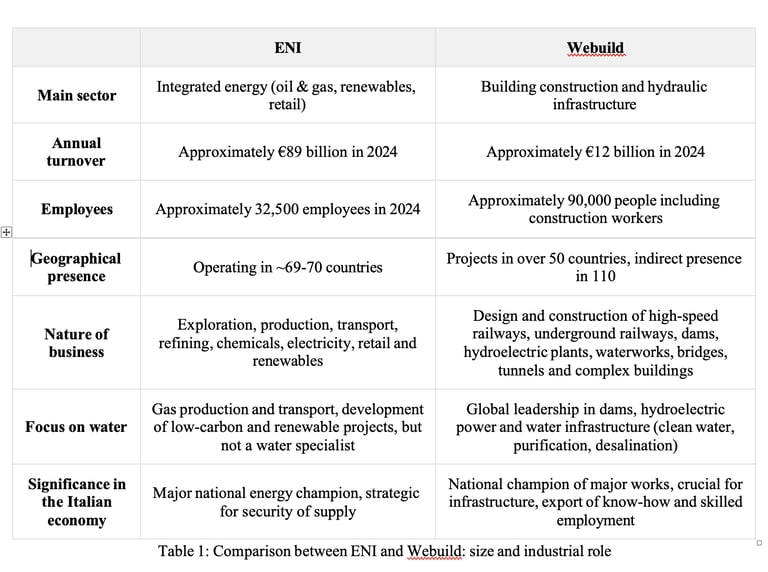
2. Two Italian industrial giants. ENI and Webuild compared
ENI and Webuild embody two complementary phases of Italy's industrial and strategic projection, almost as if they were two chapters of the same national narrative that spans the century of fossil fuels to arrive at that of sustainable infrastructure and environmental protection. ENI, founded as a public entity in the mid-20th century, built its central role on the control of hydrocarbons and its ability to transform oil and gas into a lever of foreign policy, supporting the industrialisation of our country, which emerged destroyed from the Second World War, and weaving a dense network of relationships that were very useful for Italy. Webuild, on the other hand, heir to a long tradition of construction companies and now Italy's champion of major works – mainly hydraulic but not only [1] – is at the centre of the hydro-strategic scene, making the construction of dams, hydroelectric plants, water systems and hydraulic infrastructure the preferred tool for shaping a more resilient development model that is less dependent on fossil fuels. Understanding the teleological synergies of these Italian giants can be useful in glimpsing potential common trajectories in terms of medium- to long-term strategic diplomacy.
I. ENI's consolidated strategic and energy solidity. Some examples
ENI has been, and still is, an essential industrial reality for Italy which, as mentioned, has favoured Rome's presence in many scenarios. It is not simply a large company, but one of the hubs through which our country has defined and continues to define its economic and geopolitical role in the Mediterranean, in Europe and in its relations with the Global South. Today, ENI is one of Europe's largest energy companies, with over 30,000 employees and operations in more than 60 countries, playing a central role in supplying oil and gas to Italy. Partial public control – with significant state participation through the MEF and Cassa Depositi e Prestiti [2] – reflects its function as a 'strategic asset' in national energy security.
Officially, ENI was founded on 10 February 1953, with Law No. 136 establishing the Ente Nazionale Idrocarburi (National Hydrocarbons Authority) as a public economic entity of the Italian State. As is well known, shortly after its foundation, ENI, under the leadership of Enrico Mattei, went beyond its role as a 'simple' supply agency and became an integrated operator that explored, extracted, transported and refined hydrocarbons, with a strong focus on Italian energy independence from the Anglo-American cartel of the so-called 'Seven Sisters' [3]. Among the various innovations proposed, Mattei leveraged a more equitable distribution of profits from extraction activities. The famous contractual formula that offered producing countries a more favourable distribution of profits (e.g. 75/25 instead of 50/50), creating partnerships perceived as more equitable in countries such as Egypt, Iran and then Libya, gave Italy an image of being a more reliable, less neo-colonial and intrinsically more 'friendly' partner.
Among the main activities carried out over more than seventy years of history, the six-legged dog has become an important foreign policy tool, particularly in the so-called 'Enlarged Mediterranean' (EM). In this regard, MA refers to a geopolitical and strategic concept that extends the idea of the former Mare Nostrum far beyond the maritime basin between southern Europe, North Africa and the Near East. In this sense, the Mediterranean is seen as an integrated system of seas and lands that includes, in addition to the sea itself, the Black Sea, the Red Sea, the Persian Gulf and the land regions that connect them - from the Sahel and the Horn of Africa to the inner Middle East. As a result, it is emphasised that in Italian military and diplomatic doctrine, the enlarged Mediterranean represents the area of greatest strategic interest to our country, as this space is home to the main energy, trade and migration routes that directly affect Italy's security and prosperity. As can be imagined, this is a region characterised by strong interdependence: local crises (conflicts, political instability, tensions over gas and oil, sabotage of submarine cables and infrastructure) can quickly escalate into more structured tensions capable of producing significant effects on energy prices, migration flows, maritime security and financial stability in southern Europe.
Some of the most important results achieved by the six-legged dog include the cases of Libya, Egypt and Iran.
Libya
ENI's activities in Libya are one of the historical pillars of Italy's external presence in North Africa, both in terms of energy and geopolitics. The company has been active in the country since 1959, six years after the group was founded, and is now the leading international hydrocarbon operator, with production in recent years accounting for around 80% of Libyan gas and a significant share of total hydrocarbon production, through a vast constellation of onshore and offshore concessions developed in partnership with the National Oil Corporation (NOC) [4] and within the Mellitah Oil & Gas joint venture. This presence is supported by strategic infrastructure such as the Greenstream submarine gas pipeline, over 500 kilometres long, which connects the Mellitah complex to Sicily and can transport up to approximately 8 billion cubic metres of gas per year, making the Libyan route one of the main supply routes for the Italian and European energy system.
In recent years, despite the chronic instability in the country that began with the political and physical departure of Gaddafi in 2011, ENI has consolidated its role through new gas development projects, intended both for the Libyan domestic market and for export to Europe. In this regard, the 'Structures A&E' project, signed in 2023 with an estimated investment of approximately $8 billion, involves the development of two offshore fields, with production starting in 2026 and an expected plateau of approximately 20-23 million standard cubic metres per day, accompanied by the construction of a CO₂ capture and storage plant in Mellitah, in line with the group's decarbonisation strategy . Furthermore, in 2024, ENI's gas production in Libya reached approximately 8.5 billion cubic metres, of which approximately 7 billion were used to cover up to 70% of the country's electricity generation needs and approximately 1.5 billion were exported to Italy via Greenstream, highlighting how the Rome-Tripoli energy axis remains both a means of internal stabilisation for Libya and a crucial element of Italian energy security in the wider Mediterranean.
Egypt
In its relationship with Cairo, ENI has embodied one of the main vectors of Italian foreign policy, especially after the discovery of the 'Super-Giant' gas field [5] Zohr in 2015 [6] off the Egyptian coast, which has helped transform the North African country into a potential regional hub for gas in the eastern Mediterranean and at the same time consolidate Italy's position as a key energy partner. Subsequent agreements – from billions of euros of investment in exploration and production to agreements on liquefaction and re-export of gas to Europe – have closely intertwined energy interests, security of supply and political-strategic cooperation, making the Rome-Cairo axis a delicate hub where economic opportunities and contradictions in terms of human rights and regional stability overlap7 .
It should be noted that the discovery of the Zohr field in 2015 did not inaugurate, but rather consecrated, an energy relationship between ENI and Egypt that has its roots in the 1960s, when the Italian company began operating in the country as part of Mattei's Mediterranean and Afro- Middle Eastern strategy. Zohr, with its enormous size, has transformed this historic collaboration into a true structural partnership: on the one hand, it offers Egypt the opportunity to become a gas hub in the eastern Mediterranean, and on the other, it confirms ENI – and with it Italy – as Cairo's privileged interlocutor in defining regional energy and geopolitical architectures, adding a qualitative leap in terms of interdependence, investment and political weight to a decades-long relationship.
Iran
On the Iranian front, ENI's role has historically been that of a trailblazer between Italy and Tehran, starting with the agreement signed by Enrico Mattei in 1957, long considered a model of 'equal' understanding with a producer country and a sign of autonomy from the cartel of large Western companies. In the post-war period and until the season of international sanctions following the revolutionary events of 1979, the company developed important projects in Iran - from oil fields such as Darkhovin [8] to gas fields - becoming one of the most relevant European partners for the National Iranian Oil Company and helping to keep an economic and political channel open between Rome and Tehran, albeit within the constraints imposed by the international community and US pressure.
II. Webuild's solidity in large civil engineering and water works
The history of Webuild is the most recent outcome of a long industrial journey that began at the dawn of the 20th century, when visionary entrepreneurs such as Umberto Girola and Vincenzo Lodigiani founded their construction companies in 1906, followed in the 1930s by Pietro Salini. After World War II, these companies, together with others such as Cogefar and Impresit, contributed to the creation of Impregilo in 1960, which was destined to become one of Italy's leading general contractors on major construction sites in Italy and around the world. Starting in 2011, the Salini family began a takeover bid for Impregilo, culminating in the merger of Salini into Impregilo and the creation, in 2014, of Salini-Impregilo, a new national infrastructure champion with an order book exceeding €30 billion and a track record of approximately 2,000 completed projects in over 100 countries. The transition to Webuild in 2020 marked the conclusion of the Progetto Italia (Project Italy)9 , a consolidation process that also integrated Astaldi and other important companies in the sector into the group, ushering in a phase in which the historical vocation for large civil works - dams, hydroelectric plants, high-speed railways and underground railways - was reinterpreted in an explicitly global and sustainability-oriented key, making the new brand the synthesis of over a century of engineering applied to the development of territories.
Webuild is now one of the most solid pillars of the Italian construction industry, the result of a historical stratification that began at the start of the last century, capable of competing on a global scale, with a widespread presence in Europe, North America, Australia, the Middle East, Africa and Latin America.
As a construction company in the broadest sense, Webuild has developed significant versatility over time, successfully tackling almost all types of major civil engineering works: high-capacity railway lines, urban underground railways, motorways, large bridges and viaducts, railway and road tunnels, hospitals, university complexes, stadiums and urban redevelopment projects. These are projects that require not only executive skills, but also refined expertise in structural engineering, project management, geotechnical and environmental risk management, coordination of complex supply chains and structured dialogue with public and private clients, often in demanding regulatory environments and under the watchful eye of public opinion. In this context, Webuild's strength lies in its ability to deliver complex projects in different contexts, maintaining high standards of quality, safety and sustainability.
While the company has completed major construction projects over the years, perhaps the most distinctive feature of the group is its specialisation in hydro-strategic works, an area in which Webuild excels and is widely recognised as one of the most reliable groups in the world. Throughout its history, the company has built over 300 dams and hydroelectric plants in more than 50 countries, helping to generate a total installed capacity of over 53,000 MW and while also providing reservoirs for water supply, irrigation and flood control. This experience is complemented by large water supply and distribution systems, irrigation canals, metropolitan aqueducts, wastewater treatment plants and desalination projects, often carried out through the group's specialist subsidiaries, which make Webuild a leading player in the water security of entire regions. In this context, solidity is not only technical, but also reputational. As mentioned, the company is now increasingly recognised as a reliable builder of infrastructure that supports civil, agricultural and industrial life.
From an economic and employment perspective, the group's strength is confirmed by impressive figures. Consolidated revenues stand at around €12 billion per year, up on previous years, with an order book exceeding €60 billion, ensuring visibility over several years for both business and investments. The so-called Webuild galaxy involves around 90,000-92,000 people, including direct employees and construction site workers, reflecting a critical mass that allows it to maintain a stable presence in different markets and simultaneously tackle multiple mega-infrastructure projects around the world. In addition, a very high proportion of the portfolio is linked to projects consistent with the United Nations Sustainable Development Goals, particularly in the fields of clean water, renewable energy and resilient infrastructure, which strengthens Webuild's position as a solid builder not only financially, but also in terms of social and environmental legitimacy.
One of Webuild's most emblematic hydro-strategic projects was the daring and prestigious rescue of the temples of Abu Simbel in Egypt, a feat that combined hydraulic engineering, construction skills and the protection of a cultural heritage that is extremely precious to all humanity. When the construction of the Aswan Dam and the consequent formation of Lake Nasser threatened to submerge the temples of Ramses II, UNESCO promoted a colossal international operation to save them. Within the consortium in charge of the intervention, Impregilo - now part of Webuild - was given the crucial task of dismantling the temples into over 1,000 blocks, building an artificial hill and completely reconstructing the complex 65 metres higher and 280 metres further inland, preserving its original astronomical orientation and protecting it from the rising waters of the Nile. The operation, carried out between 1964 and 1968, also involved the construction of a temporary dam 370 metres long and 25 metres high, as well as a complex drainage system, wells and complementary works, confirming the group's ability to operate in extreme hydraulic conditions while preserving assets of universal value.
Another key chapter in the group's hydro-strategic activities is the doubling of the Panama Canal, where the then Salini Impregilo led the international consortium Grupos Unidos por el Canal (GUPC) in 2016 for the construction of the Third Set of Locks, the new lock system that allowed the opening of a third waterway parallel to the historic one. The project involved the construction of two triple-jump lock complexes, one on the Atlantic side and one on the Pacific side, capable of accommodating ships up to 366 metres in length and with a capacity of up to approximately 12,600 TEU, effectively tripling the size of the vessels compared to the original locks and redefining global maritime trade flows. To complete the work, tens of millions of cubic metres of earth and rock were moved, approximately 5 million cubic metres of concrete and hundreds of thousands of tonnes of steel were used, and advanced hydraulic solutions were integrated for the reuse of water in the side tanks of the locks, thereby reducing water consumption in an area already exposed to resource stress.
____________________________________________________________________________________________________________________________________________________________________
1. Webuild is strongly committed to strategic hydraulic infrastructure – dams, hydroelectric plants, water and treatment systems – but at the same time maintains a broad focus on construction, carrying out major civil engineering and building projects: railway lines, underground railways, bridges, tunnels, hospitals and urban complexes of national and international importance. For further details on Webuild's activities, please consult the company's website: https://www.webuildgroup.com/en/group/history/.
2. The State, through the MEF and Cassa Depositi e Prestiti, holds a total of approximately 31.8% of ENI's capital, constituting a minority but de facto controlling interest, which allows it to decisively influence the company's strategy and governance.
3. The Seven Sisters were seven large Anglo-American oil companies (including Anglo-Persian/BP, Royal Dutch Shell, Exxon, Mobil, Chevron, Gulf and Texaco) which, from the post-war period to the early 1970s, controlled most of the world's reserves and coordinated prices and production as an oligopolistic cartel. Thomas, S. (2018). Corporate performance of the Seven Brothers of the European energy market: Then there were five. Utilities Policy, 50, 164– 174. https://doi.org/10.1016/j.jup.2018.01.002.
4. The National Oil Corporation (NOC) is Libya's national oil company, created in 1970 as the hub of state control over the entire hydrocarbon supply chain - from exploration to production, refining to domestic marketing and export.
5. 'Super Giant' is a technical term referring to the size of hydrocarbon deposits, used in industry and geology. Specifically for natural gas, it indicates an accumulation with resources in place exceeding approximately 850 billion cubic metres, thus placing it in the highest range of major discoveries worldwide and giving it not only economic but also geopolitical significance.
6. Already explored by other powers without success.
7. https://www.ecomondo.com/en/news-detail/italy-egypt-a-growing-partnership-economic-cooperation-and- investment-relations?newsId=2588888
8. The Darkhovin field is an oil field located in south-western Iran, near the border with Iraq, which ENI has been developing since a 2001 agreement with the National Iranian Oil Company for the first two phases of the project. The overall plan involved investments to bring production capacity up to approximately 260,000 barrels per day. For further details on the matter, please refer to this article in the Tehran Times: https://www.tehrantimes.com/news/185407/Iran-Eni-close-to-deal-on-Darkhovin-3rd-phase.
9 Progetto Italia is an operation to consolidate the Italian construction sector, promoted by Salini Impregilo to bring together the main national operators (primarily Astaldi) and create a large infrastructure group that is competitive on a global scale. https://www.webuildgroup.com/it/investitori/strategia/progetto-italia/.
3. The importance of hydro-strategic infrastructure in the modern socio-economic fabric
In the contemporary context dominated by the climate crisis and the urgent need for a sustainable transition, Webuild is emerging as a player potentially destined to have an even deeper impact than ENI had in the last century. While ENI's work was based on the availability and control of fossil fuels – oil and gas – which fuelled Italian industrial growth but also contributed to pollution and energy dependence, Webuild operates in a completely different and more vital field: water. The construction of water infrastructure, from collection to distribution, purification to resource management, places the company at the centre of a universal challenge that concerns not only economic development but the very survival of biological and social systems.
To understand the fundamental role that Webuild could play in hydro-diplomacy, following in the footsteps of ENI on the energy front – with perhaps even greater results – it is worth analysing the primordial value of so-called 'blue gold' in various areas. Water, considered in its many forms and viewed through the lens of Hydro Strategy, is much more than just a natural resource. This essential liquid material is the invisible cornerstone on which the biological vitality, social stability and productive capacity of countries, communities and societies are based. Every water infrastructure, in fact, whether it is a dam that tames the rushing course of a river, a hydroelectric power plant that transforms the motion of water into energy, a network of wells that makes deep aquifers available for supply, a bridge that connects riverbanks and stitches together territories, a canalisation system that regulates irrigation flows, a wastewater treatment plant that restores the quality of natural cycles, or a desalination plant that makes seawater drinkable – is therefore an act of engineering, but at the same time a symbol of robust strategic development. It is never just 'simple' concrete, steel or technology. On the contrary, it is the tangible manifestation of a precise political, economic and cultural choice: that of attributing to water the status of existential infrastructure for the country or community where the hydraulic work is being carried out.
As we have analysed several times in our previous reports, building hydro-strategic infrastructure means intervening in the beating heart of human and natural systems, shaping not only physical landscapes but also the geographies of power, security and development. Specifically, a dam that creates a large reservoir does not just accumulate cubic metres of water: it accumulates time, because it makes water availability cycles predictable, mitigating the severity of droughts and floods; it accumulates trust, because it offers communities and businesses the certainty that water will be available when needed to irrigate fields, supply drinking water networks and support industrial processes. A hydroelectric power plant connected to that same reservoir transforms water flow management into clean energy, strengthening the nation's energy independence and giving it additional capacity to withstand fluctuations in fossil fuel markets and the resulting geopolitical tensions. Thus, a project apparently confined to the water sector ends up having an impact on energy sovereignty, the trade balance and climate resilience, multiplying the value generated far beyond the perimeter of the construction site.
The added value of these infrastructures is particularly evident when considering the link between water and economic growth. As analysed in one of our reports some time ago, water is an essential prerequisite for any production chain: from traditional agri-food to advanced manufacturing, from energy production to the processing of raw materials. For example, a well-designed canalisation system does not simply convey water from a source to an agricultural area; it maps the productivity of entire regions, decides which lands will become fertile, which districts will be able to specialise, and which communities will be able to free themselves from food insecurity. Furthermore, a wastewater treatment plant, by returning purified and sometimes reusable water resources to the environment, prolongs the economic cycle of water and mitigates competition between agricultural, civil and industrial uses, transforming waste into a productive input while also affecting the quality of ecosystems and public health.
Similarly, wells and urban water supply networks are not merely technical devices for collection and distribution: they represent an implicit pact between the state and its citizens. Ensuring a safe, continuous and high-quality flow to homes, hospitals, schools and factories is tantamount to enshrining, in everyday practice, that the right to water – and therefore to a dignified life – is recognised and protected. When that water is reliable and accessible, the population can invest in the future: establishing families, starting businesses, planning long-term social infrastructure. When access is uncertain or unequal, however, there is a slow but inexorable erosion of social capital, fuelling conflict, forced migration and marginalisation. In this sense, the water network is as much a part of the infrastructure of citizenship as a constitution or an electoral system: it embodies this promise in the everyday act of turning on a tap.
4. Webuild's hydro-strategic potential in the teleological footsteps of ENI
ENI's experience in the 20th century showed how a national company, with strong public leadership and a long-term vision, can transform industrial expertise into a foreign policy tool, making hydrocarbons the vehicle for Italian expansion capable of profoundly affecting economic and geopolitical balances. On a different but conceptually and teleologically similar level, Webuild now has the prerequisites for a strategic projection based no longer on oil and gas, but on water and the hydro-strategic infrastructure that makes its social, agricultural, economic and energy use possible. The group's proven expertise and reliability in the management of large reservoirs, the construction of dams and hydroelectric plants, and the construction of water supply, irrigation and treatment networks, offer Webuild a real opportunity to position itself as the architect of water sovereignty in many developing countries, replicating in a sustainable way the role of 'operational arm' of the national interest that ENI assumed in the century of hydrocarbons.
Webuild has what it takes to become a real bridgehead for Italy's presence in many regions of the world, particularly where water is both a scarce resource and the foundation of any prospect for development. Thanks to its technical expertise, organisational skills and track record in major water projects, the company is able to provide entire countries with the know-how necessary to capture, harness, distribute, purify and make water drinkable, thus impacting the very heart of human security: from availability for domestic use to agricultural production, from renewable energy generation to public health protection. An entity that governs these technologies is not a simple contractor, but a structural partner, destined to take root deeply in the social and institutional fabric of the territories in which it operates, because water resource management is not an ancillary service but one of the most strategic and valuable functions of a state, in many ways even more crucial than hydrocarbon management.
The Italian hydraulic potential embodied by the former Salini Impregilo could be expressed with significant effectiveness in two particular areas of the world: Sub-Saharan Africa and Latin America.
This potential finds particularly fertile ground in sub-Saharan Africa. The combination of enormous infrastructure needs, rapid population growth and an abundance of large river basins – from the Blue Nile to the Omo, from the Congo to the equatorial lake systems – makes the region a crucial testing ground for water infrastructure. Webuild is already a key player in Ethiopia, where projects such as the Grand Ethiopian Renaissance Dam on the Blue Nile, with an expected installed capacity of 5,150 MW and an average annual production of around 15,700 GWh, and the Koysha dam on the Omo River, set to reach 2,160 MW, are helping to make the Amharic nation a potential regional energy hub and transform water into a lever for industrial development and energy exports to neighbouring countries. In such contexts, Italy, through Webuild, can strengthen its institutional role as a structural partner for the construction of integrated water systems that not only produce clean electricity but also regulate seasonal flows, support irrigated agriculture, reduce vulnerability to drought and flooding, and provide new economic opportunities for the river basins of East and Central Africa.
In Latin America, the parallel with ENI's trajectory is enriched by a further element: the historical presence of Italian communities and a dense network of economic and cultural relations, especially in Brazil, Argentina, Venezuela and Uruguay. Here, the hydroelectric potential is among the highest in the world, thanks to the presence of large rivers - from the Amazon basin to the Paraná, from the Madeira to the Magdalena - which offer enormous scope for renewable energy production. Webuild has already written significant pages in this history with projects such as the binational Yacyretá dam on the Paraná, one of the most impressive hydroelectric infrastructures in the region, capable of supplying around 60% of Argentina's hydroelectric energy and contributing substantially to Paraguay's energy balance. Similarly, in Colombia, the Sogamoso hydroelectric project, with an installed capacity of 820 MW and an annual production of over 5,000 GWh, shows how the development of Andean reservoirs can support industrial growth that is less dependent on fossil fuels and more resilient to fluctuations in international energy markets. In this context, Italy's ability to build and manage large water projects is rooted in a favourable cultural environment and can become a privileged channel for strengthening the country's presence throughout the Latin American macro-region.
Italy, understood as a country system, could benefit significantly from the global expansion of Webuild's activities in the field of water infrastructure, transforming each construction site into a more efficient and visible platform for political, economic and cultural relations at the highest level. The construction of dams, aqueducts, irrigation systems, treatment and desalination plants is not limited to solving technical problems, but has a direct impact on the quality of life of populations. In this sense, guaranteeing drinking water, continuity of supply, food security and clean energy means addressing the most sensitive core of contemporary societies' expectations and fragilities. A country that, through its own leading company, contributes to making the most biologically and economically precious commodity available, tends to be perceived not as an extractive power, but as an actor of shared development, a partner that 'brings water' in both a literal and symbolic sense.
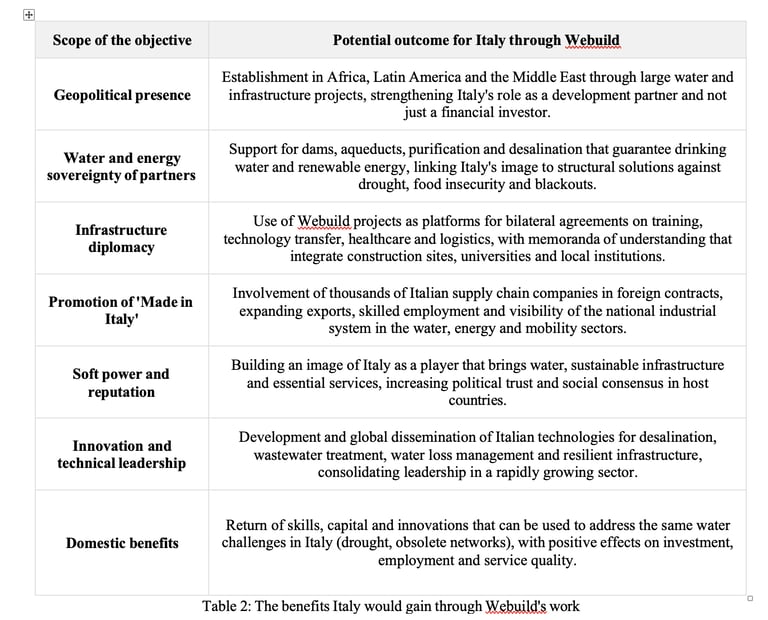
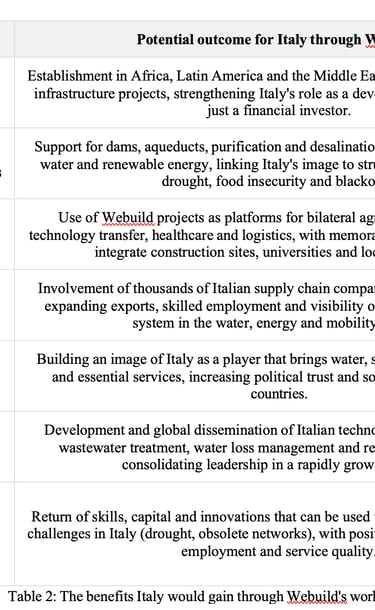
In this context, the projects carried out by Webuild can become a vehicle for profoundly positive penetration, because they link the company's name – and, by extension, that of Italy – to concrete experiences of improving living conditions. A company that ensures constant access to clean water resources enters the collective memory of the territories: the memory of a city that finally has drinking water, of a valley saved from flooding, of countryside made fertile by a new irrigation system, builds up a capital of gratitude and trust that no communication campaign could match. This symbolic capital then gives rise to broader dialogues: technical cooperation agreements, training programmes for local staff, university partnerships, joint projects in the health or education sectors that start with hydraulic works but go beyond them, transforming them into the cornerstone of a deeper structural relationship. In this way, Italy exports not only engineering skills, but also a model of external presence based on the care of a universal common good; and precisely because water is perceived as the very condition of life, the bond created through its management tends to be deeper, more lasting and more grateful than that built around hydrocarbons in the past century.
Conclusion
Webuild's field of work, focused on water management and enhancement, has even greater political and symbolic potential today than that of ENI, historically linked to hydrocarbons, which are increasingly perceived as factors of pollution and CO₂ emissions. Water is, by definition, a vital and regenerative resource: infrastructure that guarantees its availability, quality and efficient use is spontaneously associated with public health, food security, climate resilience and sustainable development. Net of the inconveniences and side effects of large hydraulic works10 , Webuild's work is thus part of a positive narrative of ecological transition, cooperation and protection of the common good, while oil and gas projects today require continuous justification in light of their environmental externalities. It is precisely in this perceptual asymmetry that Webuild's strategic advantage lies: being able to perform a function similar to that of ENI in the 20th century, but in a sector that national governments and global public opinion recognise as part of the solution rather than the problem.
If ENI, in the last century, made hydrocarbons the vehicle for an 'energy diplomacy' that helped redefine Italy's international role, Webuild can aspire to interpret a new season of infrastructure diplomacy centred on water, a primary resource and structural factor in both biological life and economic production. Hydraulic works, in Sub-Sahar n Africa as in Latin America, are not just technical works: they are instruments of power and cooperation that determine who will have access to electricity, drinking water and food security, and at what cost. By leveraging this wealth of expertise and incorporating it into a strategy consistent with Italian foreign and cooperation policy, Webuild can aspire to emulate the role that ENI played in the 20th century, but adapting it to the century of climate, environmental sustainability and, indirectly, water.
Abaqua
Via Cassia, 615
00189 Roma (RM)
© 2024. All rights reserved.
Codice Fiscale: 96584590580