
Hydro-strategy in Peru: Water Security, Climate Change and Geopolitical Implications
Jacopo Belli - May, 20, 2026
Scenario Analysis
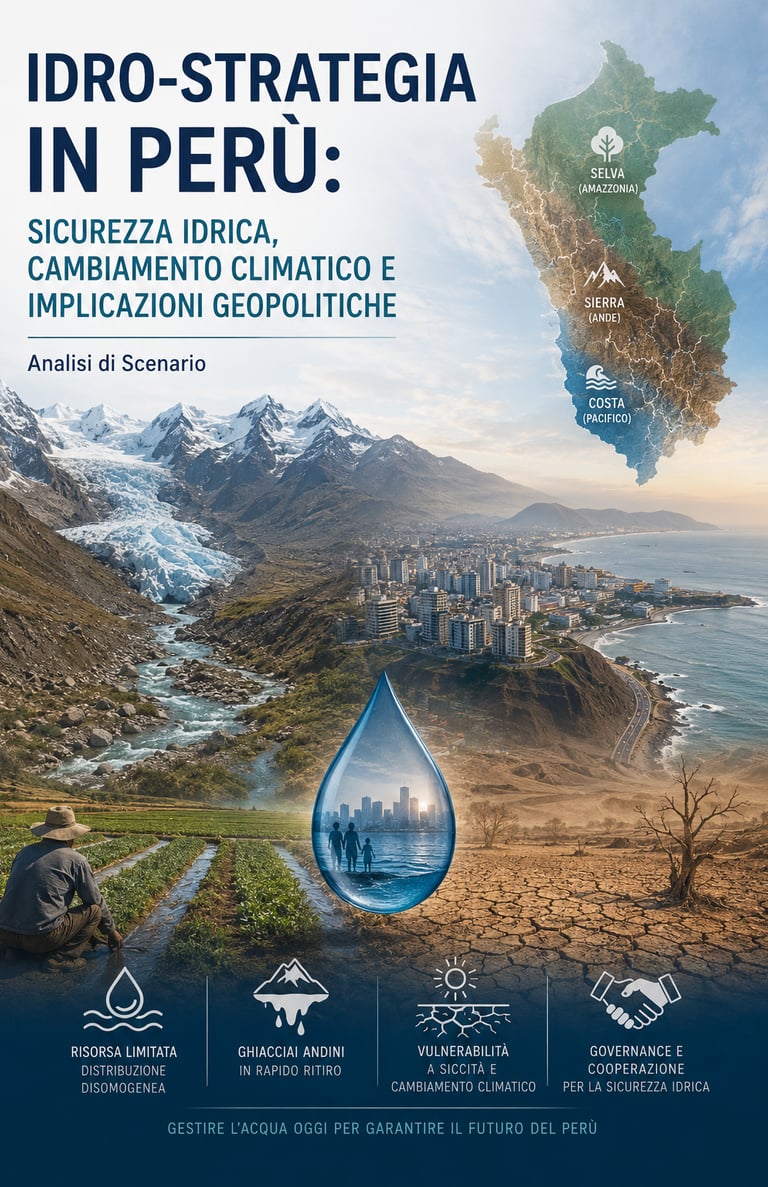
Peru occupies a strategically important position in South America due to its geographical location, biodiversity and growing economic weight. Extending from the Pacific Ocean across the Andes mountain range to the Amazon basin, the country includes an extraordinary variety of climatic zones and ecosystems. This complexity deeply influences the distribution of natural resources, particularly water, which in turn shapes patterns of economic development and human settlement. In recent decades, Peru has recorded sustained economic growth, driven mainly by mining, agriculture and industries linked to its principal export commodities [1]. Despite its evident abundance of natural resources, Peru faces structural challenges connected to the uneven distribution of water resources across the national territory. The country can be divided into three major geographical areas: the coastal region (Costa), the Andean highlands (Sierra) and the Amazon basin (Selva). Each of these areas presents very different hydrological conditions and demographic dynamics. While the Amazon basin has vast freshwater reserves, the coastal region, where most of the population and economic activity are concentrated, is predominantly arid and depends heavily on water originating in the Andean mountains [2].
Around two thirds of the population live in the Pacific region along the coast. However, this area has only about 1.7% of the country’s total water availability, creating a strong imbalance between water demand and supply [3]. This mismatch between water availability and population distribution represents one of the country’s main hydro-strategic challenges.
The concentration of population and activity in coastal areas has historical roots. Today, Lima alone hosts around one third of the national population and is the country’s main industrial and political centre. More than 71% of the renewable water available in the Pacific basin is consumed every year, increasing the region’s vulnerability to drought and climate variability [4].
This vulnerability became evident in 2016, when the Peruvian Government declared a state of emergency due to water deficit in all departments of the Pacific region, highlighting the structural fragility of the water-resources management system and the urgent need to improve water governance [5].
The water supply of the coastal region depends on rivers that originate in the Andes, the mountain range that performs the country’s hydrological regulatory function. The Andes host high-altitude ecosystems and glacier-fed basins that provide water resources for urban consumption, agricultural irrigation and downstream industrial activities. However, this dependence on Andean systems exposes Peru to significant risks linked to climate change. The Andes contain around 70% of the world’s tropical glaciers, which act as natural reservoirs capable of regulating seasonal water flows and sustaining river discharge during periods of drought [6].
As is widely known, because of climate change these glaciers are retreating rapidly. Scientific studies estimate that Peru has already lost more than 40% of its glacier surface since the 1970s, reducing the capacity to stabilise water availability and increasing discontinuity in the supply of water resources [7].
In the broader Latin American context, Peru represents the paradox of a territory characterised by overall water abundance but by logistical scarcity in terms of territorial water management. Although Latin America possesses a significant share of global freshwater resources, their distribution remains extremely uneven across regions and ecosystems. As a result, countries such as Peru are increasingly required to develop integrated water-resources management strategies capable of reconciling economic development, environmental sustainability and social sustainability.
Hydro-strategic Challenges in Peru
Water governance in Peru represents one of the most complex challenges for the country’s long-term development. A combination of factors, including the unequal distribution of water resources within the territory, the growth in demand in urban conglomerates also linked to industrial expansion, and climate change, has generated increasing pressure on the national hydrological system.
These dynamics are evident in coastal regions, where demographic concentration and economic development have intensified competition for limited water resources [8].
Intense urban growth has been one of the main drivers of increasing water demand in Peru. Lima, located in one of the most arid regions in the world and with a population approaching ten million inhabitants, has become one of the largest metropolitan areas in South America. However, the city’s water infrastructure struggles to keep pace with rapid urban expansion, particularly in peripheral areas where access to water services remains limited and poor. In many of these areas, households rely on water transported by tanker trucks rather than on public water networks. This results in higher costs than those borne by households connected to municipal networks, creating significant inequalities in access to water and highlighting the structural weaknesses of urban water-resources governance [9].
Agriculture represents a fundamental component of water consumption in Peru, accounting for the main share of freshwater withdrawals, particularly where agro-industrial production has expanded considerably in recent decades. Export-oriented native crops such as asparagus, avocado and grapes require large quantities of water, further increasing pressure on water basins. At the same time, many irrigation systems remain inefficient, with considerable losses during water distribution and use. Improving irrigation efficiency is therefore a fundamental component of national water-resources management strategies, especially in a context of growing water scarcity and greater climate variability [10].
Another key dimension is the mining sector. Peru is one of the leading producers of copper, silver and gold, and mining activities are a fundamental source of national revenue and foreign investment. However, mining operations often take place in high-altitude Andean regions, where water resources are essential for local agriculture and natural ecosystems. This overlap frequently generates conflicts among mining companies, local communities and government authorities. Concerns relating to water contamination, the reduction of local water resources and environmental degradation have caused numerous social conflicts in the country’s mining regions. In some cases, disputes over access to water have led to protests, project delays and political tensions, demonstrating the complex relationship between economic development in this sector and environmental governance [11][12].
Hydro-politics and Climate Security in the Andes
Water security in Peru cannot be fully understood without considering the broader regional dynamics of the Andean area. As noted above, the Andes mountain range represents one of the most important hydrological systems in South America, functioning as a true natural source of water for several countries, including Peru, Bolivia, Ecuador, Colombia and Chile. Rivers originating in the Andes supply millions of people and sustain agricultural and economic systems across the continent. Consequently, the environmental changes affecting the Andean cryosphere have implications that go beyond national borders. Climate change is significantly transforming the hydrological dynamics of the Andean region, as rising temperatures, by accelerating the retreat of tropical Andean glaciers, have destabilised the seasonal regulation of water flows.
The consequences of these changes are particularly relevant not only from an economic and industrial perspective, but also from the standpoint of national security, as they increase the likelihood of extreme hydrological events such as floods and droughts. This growing variability complicates long-term water planning and raises concerns about the region’s future water security. Beyond environmental impacts, these dynamics also carry important geopolitical implications. In the Andean region, competition for water resources poses a challenge not only among economic agents and across the sectors outlined above, but may also become a precursor to future instability among political actors [13].
Although conflicts between states over access to water resources remain relatively rare in Latin America, tensions at the subnational level are more frequent. In Peru, for example, disputes among local communities, mining companies and government authorities have often focused on issues relating to water quality and access to water resources. These conflicts show how the challenges linked to water governance can intersect with broader questions of environmental justice, indigenous peoples’ rights and economic development. In response to these challenges, several regional and international organisations have promoted initiatives aimed at improving water governance and strengthening climate-adaptation strategies in the Andean region. Institutions such as the World Bank, the Inter-American Development Bank and the Economic Commission for Latin America and the Caribbean (ECLAC) have supported programmes focused on integrated water-resources management, glacier monitoring and the strengthening of climate resilience [14].
Strategic Outlook and Policy Implications
The hydro-strategic challenges faced by Peru highlight the growing importance of water security as a fundamental dimension of national development and regional stability in Latin America. The structural imbalance in water governance creates a complex political context in which reconciling environmental sustainability, economic growth and social equity becomes particularly difficult.
Over the coming decades, climate change is expected to intensify many of the hydrological pressures already affecting the country. Technological innovation and improved hydrological monitoring, however, will play a fundamental role in future water-governance strategies. Investments in glacier monitoring systems, hydrological modelling and early-warning systems can help policymakers anticipate water shortages and extreme climate events. At the same time, improvements in irrigation technologies and water-efficient agricultural practices could significantly reduce pressure on freshwater resources in the main productive areas [15].
Another important policy dimension concerns the inclusion of local communities and indigenous populations in water-governance processes. As highlighted above, many water sources originate in high-altitude Andean territories inhabited by indigenous communities whose livelihoods depend on fragile ecosystems. Ensuring their participation in decisions concerning water-resources management is therefore essential both for environmental sustainability and for reducing the risk of social conflicts linked to resource exploitation and infrastructure development [16].
In this context, projects are emerging that begin to respond to this need by promoting models based on the direct involvement of local communities, guaranteeing them not only access to essential services but also lasting participation in governance mechanisms. Projects such as RenovaVida fit within this approach, with the aim of establishing a stable presence in these territories and fostering inclusive development through the provision of basic services and community-oriented infrastructure.
At the regional level, strengthening cooperation among Andean countries will become increasingly important. Shared environmental challenges require strong diplomatic commitment, coordinated scientific research and broader policy responses. In this context, regional cooperation frameworks for climate adaptation and water-resources governance could play a crucial role in strengthening the resilience of the entire Andean region.
___________________________________________________________________________________________________________________________________________________________________
References
[1] UNESCO, 2023. United Nations World Water Development Report 2023: Partnerships and Cooperation for Water. Paris.
[2] OECD, 2021. Water Governance in Peru. Paris: OECD Publishing.
[3] AUTORIDAD NACIONAL DEL AGUA (ANA), 2019. Recursos hídricos del Perú. Lima: ANA.
[4] WORLD BANK, 2016. High and Dry: Climate Change, Water, and the Economy. Washington, DC: World Bank.
[5] GOVERNMENT OF PERU, 2016. Decreto de emergencia por déficit hídrico en la vertiente del Pacífico. Lima: Government of Peru.
[6] VERGARA, W. ET AL., 2009. The Potential Consequences of Climate Change for Tropical Andean Glaciers. Washington, DC: World Bank.
[7] VUILLE, M. ET AL., 2018. Rapid decline of snow and ice in the tropical Andes – Impacts, uncertainties and challenges ahead. Earth-Science Reviews, 176, pp.195–213.
[8] INTER-AMERICAN DEVELOPMENT BANK (IDB), 2020. Water and sanitation in Latin America and the Caribbean. Washington, DC: IDB.
[9] WORLD BANK, 2017. Peru Urban Water Supply and Sanitation Sector Review. Washington, DC: World Bank.
[10]FAO, 2019. Water for Sustainable Agriculture in Latin America and the Caribbean. Rome: Food and Agriculture Organization of the United Nations.
[11]BEBBINGTON, A. AND BEBBINGTON, D.H., 2011. Mining, water and social conflict in Peru. World Development, 39(2), pp.288–301.
[12] DE ECHAVE, J., DIEZ, A., HUBER, L., REVESZ, B., RICARD, X. AND TANAKA, M., 2009. Mining and Social Conflict in
Peru. Lima: Instituto de Estudios Peruanos.
[13]BUYTAERT, W. AND DE BIÈVRE, B., 2012. Water for cities: The impact of climate change and demographic growth in the tropical Andes. Water Resources Research, 48(8).
[14] ECLAC (ECONOMIC COMMISSION FOR LATIN AMERICA AND THE CARIBBEAN), 2022. Climate change and water resources in the Andes. Santiago: United Nations.[15]FAO, 2021. Water efficiency and agricultural sustainability in Latin America. Rome: Food and Agriculture Organization of the United Nations.
[16] BOELENS, R., HOOGESTEGER, J., SWYNGEDOUW, E., VOS, J. AND WESTER, P., 2016. Hydrosocial territories: A political ecology perspective. Water International, 41(1), pp.1–14.
Abaqua
Via Cassia, 615
00189 Roma (RM)
© 2024. All rights reserved.
Codice Fiscale: 96584590580